Just like a membrane is part of the tissue, or like fat cells are joint to it.
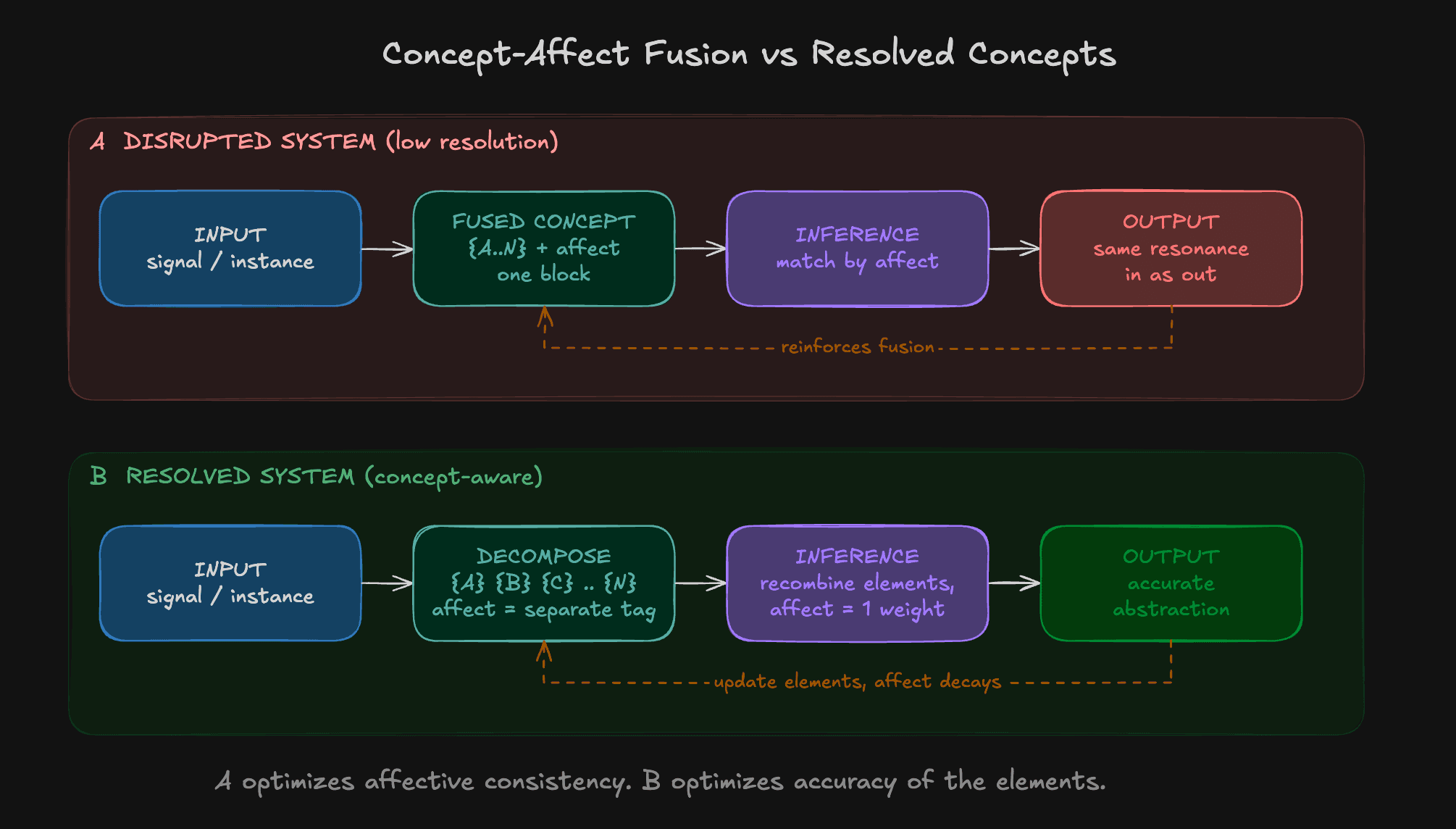
People with low resolution or affective-dominant minds are unable to produce accurate abstract thinking because they generally can’t get rid of the affective vector who generated their instance in the first place, that’s attached to the elements composing the thought.
They have trouble unlearning the seeds generated by statistical or salient learning of prediction errors, and therefore they only produce inference from the model with the same affective resonance as it generated.
Some of these individuals can be absolutely blind to the founding set of elements of a concept A,B,C,...,N and say things like:
(Chosen by how often these come up in families and how many other scripts they explain)
You haven't called in two weeks. I guess you've forgotten you have a mother.
The prior links contact frequency to how strong the bond is. Silence creates a prediction error. Because the fear of losing the bond carries high precision, the error gets explained by "bond decay" instead of workload, time zones or habit.
After everything I've done for you, this is how you treat me?
A local error (a limit on one behavior) spreads through the whole history of the relationship. The model can't isolate the error by context, so one boundary updates the entire relational prior at once.
You used to tell me everything. Now it's like I don't even know you.
The prior is fixed to an earlier developmental state and never updated. The child's individuation is a normal drift in the hidden causes, but it's read as a violation. Failing to update the model gets experienced as losing the person.
It's not what you said, it's how you said it.
The content turns out to be neutral and matches no threat, so the prediction error has nowhere to go. It gets moved onto tone, a signal too faint to disprove. There, a heavily weighted attachment prior reads hostility into it. The hurt is the listener's own prediction, credited to the speaker. Inventing an unfalsifiable channel is how the fused concept protects itself from revision.
Together these cover the main situations: absence, a vague signal, a boundary, a lapse, and the other person changing over time.
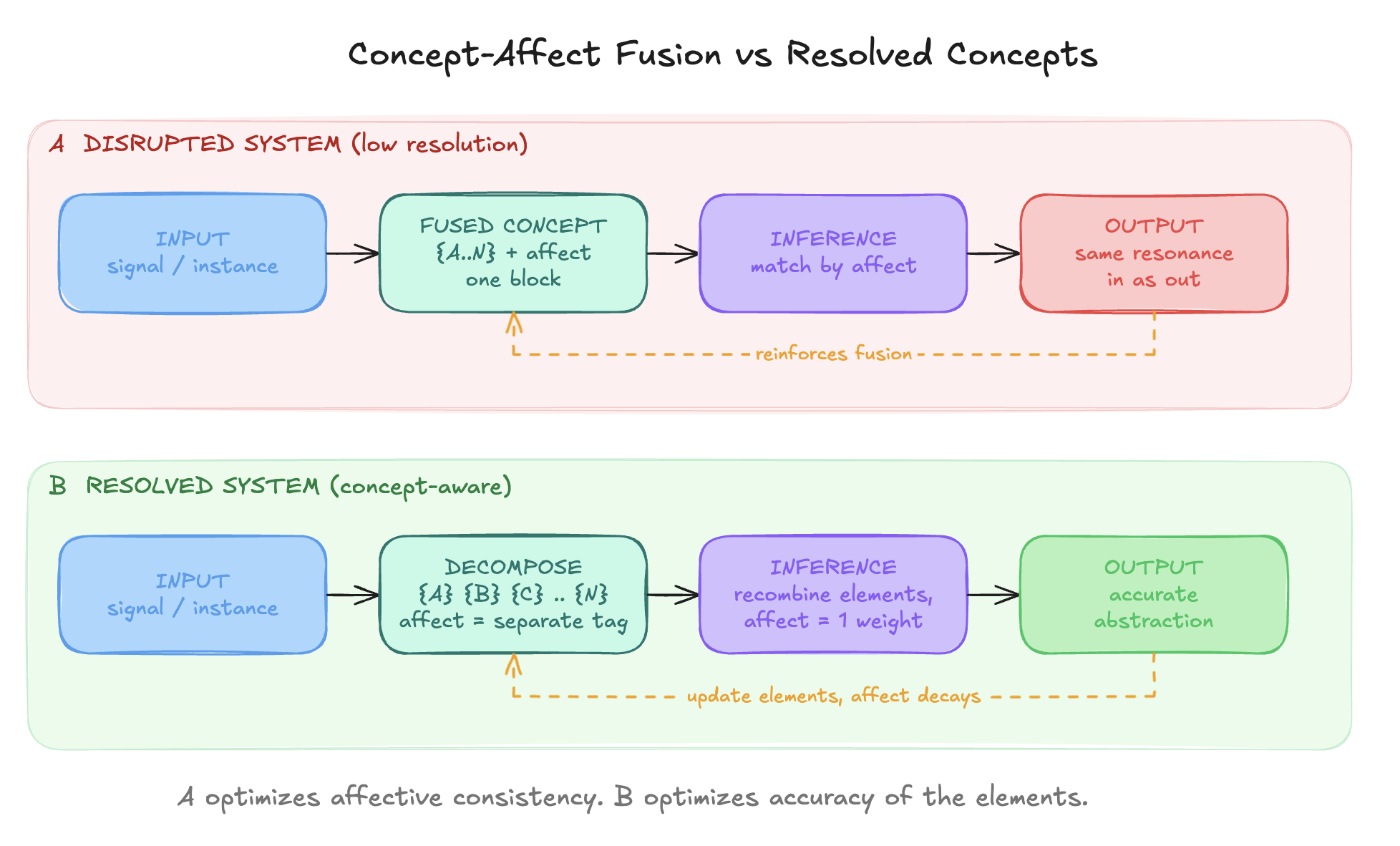
In the disrupted system, an input activates a concept whose elements A,...,N are fused with the affect that seeded them. Inference matches by affect, reproduces the same resonance, and reinforces the fusion. In the resolved system, the input is decomposed into separate elements with affect as its own tag. Inference recombines the elements with affect as a single weight, producing accurate abstraction while the affect decays. A optimizes affective consistency, B element accuracy.
It’s interesting as well, that you can take advantage of the sticky sub-instances surrounding a concept (near neighbors), to leverage the persuasion of the person’s point, or to deconstruct/dearticulate them. If a higher res inference model detects that instances that the lower res does not, it can hijack or instrumentalize them at its advantage.
This can also be used massively in mainstream or popular narratives, where people are likely to predict something close to the instance, but not being able to identify that they 'come' together, and then verbalizing or materializing it generates dominant salience, agitation, or memefication.
This is what I call Arbitrage of Inference Resolution.